Dumpster Diving for Dopamine: How Garbage Is Becoming the Hottest Art Medium in America
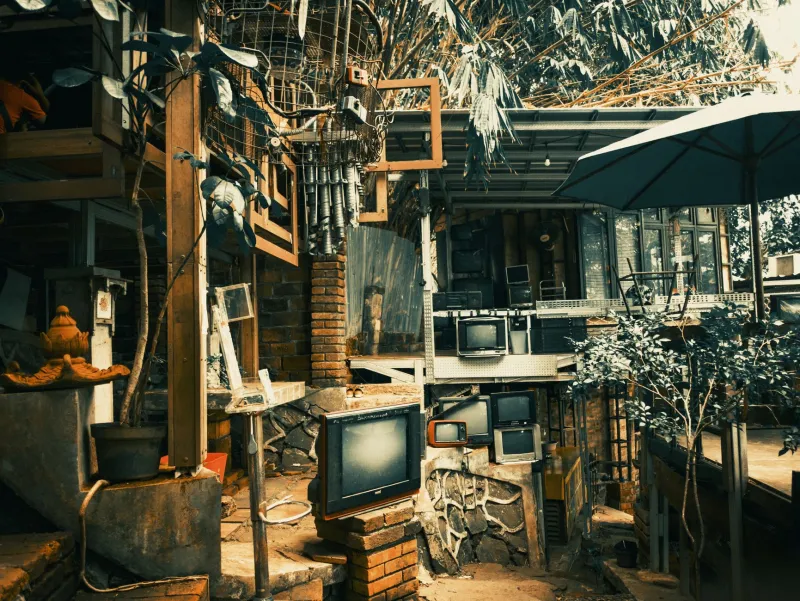
There's something deeply satisfying about watching someone build something beautiful out of something broken. Not in a Pinterest-crafts kind of way — we're talking about full-scale gallery installations built from busted CRT monitors, tangled cassette tape, industrial scrap metal, and the kind of textile waste that fast fashion brands would rather you didn't think about. Across the US, a growing crew of artists is doing exactly that, and the results are genuinely, wildly stunning.
This isn't your grandmother's recycled-bottle wind chime. This is chaos art with a conscience.
The Movement Has a Name (Several, Actually)
Depending on who you ask, it goes by trash art, junk art, found-object sculpture, or upcycled installation work. The academic crowd might call it "assemblage" — a term that traces back to Jean Dubuffet in the 1950s — but today's practitioners aren't particularly interested in art history gatekeeping. What unites them is a shared obsession with the discarded, the overlooked, and the supposedly useless.
Detroit-based artist Marcus Webb has been pulling electronics from e-waste drop-off sites for nearly a decade. His massive wall installations — cascading towers of stripped circuit boards, tangled wiring, and cracked phone screens — have shown at galleries in Chicago, Brooklyn, and Austin. "People walk past this stuff every single day," he told us over the phone. "A dead laptop is just a dead laptop until you start seeing it as texture, as color, as material. Then it becomes something else entirely."
That shift in perception — from waste to resource — is exactly what's driving the movement's momentum.
Why Now? The Cultural Perfect Storm
A few forces are colliding at once to make trash art not just viable but urgent. Americans generate over 290 million tons of solid waste per year, according to the EPA. The climate conversation has never been louder. And simultaneously, the art world is hungry for work that feels raw, authentic, and politically charged rather than polished and market-safe.
Trash art checks every single one of those boxes.
In Los Angeles, artist collective Tierra Rota (loosely translated: broken earth) has been staging guerrilla installations in public spaces — think abandoned strip mall parking lots and underpass walls — using discarded furniture, broken appliances, and reclaimed industrial materials. Their work doesn't ask permission. It just appears overnight, enormous and undeniable, and forces passersby to reckon with what they've thrown away.
"We're not trying to make something pretty," says collective co-founder Yara Mendez. "We're trying to make something uncomfortable. The beauty is almost accidental. What we're really doing is holding up a mirror."
That confrontational energy is part of what separates this wave of creators from hobbyist upcyclers. There's genuine anger here, and genuine artistry.
From Textile Waste to Textile Triumph
It's not just electronics and metal. The fashion industry's staggering waste output — an estimated 92 million tons of textile waste globally per year — has become raw material for a whole other branch of the movement.
New York-based fiber artist Deja Holloway spends weekends combing through textile recycling bins and thrift store castoffs, pulling synthetic fabrics, tangled thread, and damaged garments that nobody wanted. Back in her Brooklyn studio, she weaves, knots, and layers these materials into enormous wall hangings and three-dimensional sculptural forms that blur the line between fashion, craft, and fine art.
"Fast fashion companies want you to see a worn-out shirt as garbage," Holloway says. "I see a worn-out shirt as a document — it has a history, it has texture, it has a life. My job is to give it another one."
Her recent installation at a Lower East Side gallery — a floor-to-ceiling cascade of knotted synthetic fabric in muted earth tones — sold out before the opening reception. The materials cost her essentially nothing.
Start Your Own Trash Art Practice: A Beginner's Chaos Guide
Ready to raid your own recycling bin? Good. Here's how to start without overthinking it.
Step 1: Develop Your Collector's Eye Before you make anything, spend two weeks just looking. Walk your neighborhood differently. Notice what people throw away — the shapes, textures, and colors of discarded objects. Old venetian blinds, broken umbrellas, worn shoe soles, wine corks, takeout containers. Start seeing materials instead of garbage.
Step 2: Build a Materials Stockpile Designate a corner of your garage, basement, or apartment for collected materials. Good starting points: e-waste collection events (often free and local), textile recycling bins, curbside heavy-trash days, construction site dumpsters (ask permission first), and thrift stores selling items by the pound.
Step 3: Pick a Constraint The best trash art usually has a conceptual anchor. Try limiting yourself to materials of a single color. Or materials from a single category (only paper, only plastic, only metal). Constraints breed creativity when you're working with chaos.
Step 4: Start Small and Weird Don't start with a 10-foot installation. Start with a shadow box. Arrange, rearrange, glue, wire, and layer materials in a small contained space. Get comfortable with the unexpected combinations that emerge when you stop controlling everything.
Step 5: Document Everything Shoot your process. The mess, the experiments, the failures. Trash art is as much about the story as the final object, and that story belongs on your Instagram, your TikTok, your wall.
The Gallery World Is Finally Paying Attention
For years, waste-based art occupied an awkward space between activism, craft, and fine art — too political for some collectors, too material-focused for others. That's changing fast. Major art fairs are now actively seeking out work that engages with environmental themes, and galleries from Miami to Portland are dedicating entire shows to found-object and waste-based practices.
More importantly, audiences are responding. People are exhausted by the pristine and the expensive. They want art that feels alive, imperfect, and honest about the world we're actually living in.
And the world we're actually living in has a lot of garbage.
The trash-art movement understands something fundamental: beauty isn't reserved for new materials and clean surfaces. Sometimes the most powerful thing you can make is something that looks exactly like the mess we've made — and makes you love it anyway.
Now go check your recycling bin. Your next masterpiece is probably in there.