Accident Architects: The Artists Who Engineer Beautiful Mayhem
There's a myth floating around art school hallways and Pinterest mood boards that great work comes from ironclad vision — the artist as a god-like planner who sees the finished piece before the first brushstroke. But walk into the studios of some of America's most exciting experimental creators, and you'll find something messier, louder, and way more interesting going on.
These makers aren't winging it. They're engineering the conditions for beautiful disasters.
The Paradox of Planned Unpredictability
Call it controlled chaos, structured serendipity, or just really confident letting-go — there's a whole community of artists who've built their practices around a deceptively simple idea: set up the right conditions, then get out of the way.
Tamara Osei, a ceramicist based in Asheville, North Carolina, describes her process as "building a stage and then letting the fire direct the play." She spends weeks engineering specific clay bodies, glaze chemistries, and kiln atmospheres — variables she can nudge but never fully command. "I know roughly what temperature does to this particular iron oxide," she explains. "But I can't tell you exactly what I'm going to pull out of that kiln. That gap between what I know and what I don't? That's where my work lives."
For Osei, the methodology isn't about laziness or leaving things to chance in some romantic, unexamined way. It's rigorous. She keeps meticulous firing logs, photographs every single piece before and after the kiln, and annotates her glazing notes with outcomes — both the disasters and the revelations. Over time, those logs have become a kind of map of the unpredictable, a personal encyclopedia of happy accidents she can almost — almost — reproduce.
Setting the Chaos Parameters
The key word in "controlled chaos" is, obviously, controlled — at least partially. Every artist working in this space talks about the importance of defining what they call their "accident zone," the specific variables they're willing to surrender while keeping everything else locked down.
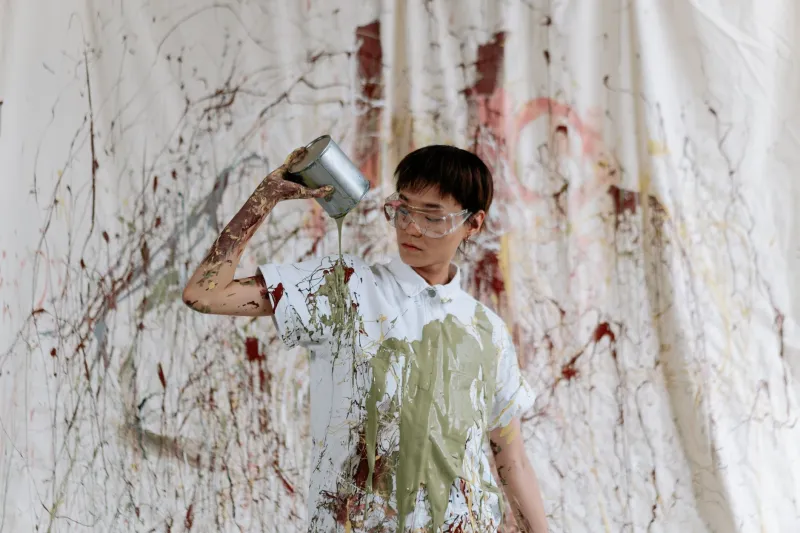
Marcus Bell, a Brooklyn-based abstract painter whose large-scale canvases have shown up in galleries from Chelsea to Chicago's West Loop, works with gravity as a collaborator. He mixes his own paints at specific viscosities, angles his canvases at calculated degrees, and then pours. "I'm not just throwing paint at a wall," he says, with the slightly defensive laugh of someone who's had to explain this distinction approximately ten thousand times. "I've spent years understanding how this particular medium moves on this particular surface. I'm making hundreds of micro-decisions before I ever introduce the variable I don't control."
Bell's accident zone is the pour itself — the precise moment when physics takes over from intention. Everything upstream of that moment is craft. Everything downstream is documentation, curation, and the willingness to recognize something great when it shows up uninvited.
That willingness, it turns out, is its own skill.
Happy Accidents Aren't Actually Random
Ask any of these artists about their "best" accidents, and you'll notice something: the stories always involve a foundation of deep technical knowledge. The happy accident that changed Osei's career — a crystalline glaze formation she'd never seen before — happened because she'd been firing for six years. She knew enough to recognize it as extraordinary rather than defective.
"Beginners have accidents too," she points out. "They just don't always know what they're looking at."
This is the dirty secret of the controlled chaos methodology: you can't meaningfully embrace unpredictability until you've put in the hours to understand what predictability even looks like in your medium. The chaos is only interesting in contrast to the control.
Music producer Deja Fontaine, who works out of a home studio in Atlanta and has built a cult following for her genre-blending beats, takes a similar approach in a completely different medium. She'll deliberately run audio signals through broken or degraded equipment, introduce analog tape hiss into digital sessions, or process samples through chains of effects she hasn't fully mapped yet. But she does it from a foundation of classical music training and years of technical production work. "I know music theory well enough to hear when a 'mistake' is actually a new chord voicing I'd never have written on purpose," she says. "You have to know the rules before you can love breaking them."
Documenting the Wreckage (And Mining It for Gold)
One of the most consistent practices across every maker in this space is obsessive documentation. Notebooks, voice memos, photo archives, video recordings of process — the accidental aesthetic only becomes a signature aesthetic when you can study it, learn from it, and find ways to invite it back.
Bell photographs every stage of every pour, including the ones he ultimately paints over or discards. Osei's firing logs go back nearly a decade. Fontaine keeps a folder she calls "beautiful failures" — stems, loops, and half-finished tracks that didn't work in context but might unlock something later.
"Most people throw away the accidents," Fontaine says. "I think that's where the most original stuff hides."
This archival impulse transforms chaos from a one-time event into a resource. It's the difference between stumbling into something once and building a vocabulary.
The Business Case for Letting Go
Beyond the creative philosophy, there's a practical argument for this approach that's hard to ignore: it works commercially. Osei's pieces sell out at craft fairs and online drops. Bell's pours command serious gallery prices. Fontaine's production credits are growing fast.
Part of the appeal is authenticity — in a design landscape increasingly saturated with AI-generated smoothness and algorithmic perfection, work that carries visible evidence of process and unpredictability stands out. Collectors and fans can feel the humanity in it.
But there's also a sustainability argument. Artists who rely on rigid, reproducible systems can burn out chasing consistency. Artists who've learned to work with unpredictability tend to stay curious longer. Every session holds the possibility of surprise. Every firing might produce something they've never seen before.
"I've never once been bored in my studio," Osei says. "How could I be? I genuinely don't know what's going to happen."
That might be the most radical thing an artist can say in 2024 — and the most honest creative flex of all.
So, Can You Learn to Embrace the Chaos?
The good news is yes. The slightly humbling news is that it takes work. Start by identifying the one variable in your process you're most afraid to relinquish — and experiment with loosening your grip on it. Just that one. Document everything. Study the results without judgment. Look for the moments that surprise you and ask why they work.
Build your technical foundation deep enough that you can recognize a gift when chaos delivers one.
And maybe, just maybe, stop trying to control everything long enough to see what shows up when you don't.